Month: July 2019

Jason_and_Steve_UCEMC_Lineman.png

Close Call! Cookeville UCEMC Linemen Narrowly Escape Driving into Flood-Ravaged Ravine

On Saturday, July 13th, a severe storm hit Putnam County, causing creeks to overflow with five inches of rain. A bridge near Dyer Creek Road collapsed. As the rain poured in, so did calls to already-stressed 911 operators, as they frantically dispatched crews to rescue people standing atop their vehicles to escape rising water on the roadways. Trees fell, and bolts of lightning trekked across the sky, striking transformers and lines, knocking out power to hundreds of people for twelve hours. 

That’s when Jason Huddleston and Steve Robinson get busy. For these UCEMC linemen, restoring electricity during a violent storm is just part of the job. It’s expected. But what they didn’t expect was almost driving their 40,000-pound bucket truck into a 14-foot ravine – opened up by a raging creek.

Heavy rain was pounding the windshield around 7:45 when Jason and Steve left for this outage call. They could barely see to find the secluded road of the UCEMC member reporting the outage. When the crew arrived, a powerful surge of water was already inching up over the member’s concrete driveway from a creek below, but they passed through and made it safely to the home high atop a hill.

Once they determined that lightning had struck a transformer near the house, the crew headed back down the driveway with Jason slowly leading the way in the bucket truck and Steve following in a pick-up. That’s when Jason says; the earth opened up.

  “It was dark, and the rain was coming down so hard we could barely see,” Jason recalls. “We get to the end of the driveway, and I could see the bank collapsing right before my eyes – the grass, the dirt, the concrete – there was tiling under the driveway, but it was already sucked up in the current and was gone. I stopped the truck just inches before it went off into that deep water. I had to quickly back the truck away from the edge because I was afraid the weight of the vehicle would make more of the bank collapse,” says Jason.  “We were stuck and weren’t going anywhere. We had to call James Dennis, our supervisor, to rescue us – he brought a digger truck with a bucket on it and parked it as close to the edge on the other side. He stretched the arm of the bucket across the water and set the bucket down on the driveway. Steve climbed in and got across first; then it was my turn.  I was grateful to get out of there alive! I wanted to kiss the ground when I got to safety.”  

Dennis, UCEMC’s District Manager in Cookeville, is proud of the crew and their quick reaction. “These men work in extreme conditions and do a great job. Fortunately, they were very cautious as they were driving and were able to avoid a potentially deadly accident.”

Dennis reports that storm damage affecting about 760 UCEMC members occurred on Dodson Branch Road after a tree fell and broke a pole.  In all, 900 members were affected by the storm. Power was restored to all by Sunday morning.

Grant photo

Writing a UCEMC Cares Grant

Grant photo

     It’s easier than you think!                         

     The first thing you need to know about writing a UCEMC Cares grant is that there is very little writing involved. The downloadable and user-friendly CARES grant application makes it an easy process. Answer the simple questions about your organization, agency, or non-profit, and that’s it!

     Organizations that receive funds aren’t required to have a formal 501 (c) status, but they do need to be operated as non-profit entities for non-profit activities. A bank account bearing the organization’s name and Tax ID number is essential to have on hand before applying for the grant. Unlike other awards that may require page after page of testimonials and descriptive explanations, the UCEMC Cares grant allows you to get straight to the point. 

     The UCEMC Cares Board of Directors meets the second Tuesday of each month and chooses the grant recipients from these applications at that time. The Cares board is made up of a group of volunteers – community leaders from each district. It’s their task to read your application and learn more about what your organization does for the community and how you’re doing it. They want to know how much money you’re requesting and exactly how you plan to use it. Do you receive other grants? You’ll be asked to list those. What needs will be addressed upon completion of this project? Do you have enthusiastic volunteers who will put in a good word for the organization’s work? The form asks for references, both inside and outside of your circle, who have witnessed the benefits the group brings to the community.

     There’s plenty of room for creativity on this application, so go ahead and express yourself! Getting the word out about your organization helps everyone. Here’s what’s good about that: if your organization isn’t awarded a grant this month, you may reapply the following month. There are many opportunities to get the financial help your group needs. Send in applications by the first of the month and remember that patience and consistency are essential when applying/re-applying for any grant.

     Grant money cannot be used for “capital improvements” on governmentally-funded buildings for permanent building or property renovations. These funds may not be used to support any candidate or political purpose, nor may they be used to pay energy bills or charges. Schools and churches are not eligible to receive funds; however, groups or initiatives within the school or church, such as chartered clubs, booster clubs, parent-teacher organizations, food banks, and youth groups are eligible. 

     Here are just a few of the examples of grants previously awarded to groups providing these services for the community:

     Books and supplies for a children’s library;

     Fees and scholarships for a children’s summer camp;

    Cheerleading and band uniforms;

    Cheerleading and band camp fees;

    Athletic and safety equipment such as helmets, pads, harnesses;

    Safety and firefighting equipment for volunteer fire departments;

    Equipment to aid special needs children who are learning to ride horses;

    Trip fees for students to attend leadership and academic conferences;

      Children, whose families can’t afford the high fees for summer camp, can now participate and join in the fun with their friends, thanks to a CARES grant. Special needs children who feel they will never play sports or ride a horse are experiencing the thrill of the game and the joy of inclusion, because of Cares. Those young football players are running for touchdowns with confidence because they know they’re wearing gear protecting them from harm. Our firefighters can now call for backup and know that their transmission can be heard thanks to the latest radio technology and a Cares grant. 

      When UCEMC members choose to “opt-in” to the Cares program and round-up their bill each month, that small change can add up to significant change for the community with your help. 

      Thank you for all that you do to make the Upper Cumberland one of the safest, kindest communities in the nation. Please contact us through UCEMC’s corporate office if you have any questions about Cares grants or the Cares program. 


IMG 0893

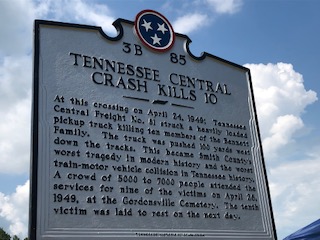
Historical Marker Dedicated at Train Crash Site

IMG 0893

On the night of April 24, 1949, ten members of a Smith County family died when Jesse Bennett pulled his fully-loaded pick-up truck into the path of a fast-moving Tennessee Central freight train near the intersection of Lancaster Highway and Stewart’s Bend Lane. The family had just left a church revival.

Killed were Jesse Bennett, 50; his wife Mattie, 45; their three young sons: Melvin, 8, Douglas, 12, and U.L., 10, Littie and Paulie Dickens, both 24, Kathryn Dickens, 1, W.E. Bennett, 49, and Linnie Gibbs, 17. An eleventh passenger, Ruth Robinson, 15, suffered severe injuries but was the only survivor of the fiery crash.

 The story made national headlines, and in the days following the accident, more than 7,000 people traveled to tiny Gordonsville, Tennessee to attend the mass funeral.     

 Today, this historical plaque marks the site and tells the tragic story for generations to come thanks to the efforts of the Smith County Leadership Opportunity Class of 2018 who chose the marker as their community service project.  

 The Leadership Class applied for and received a UCEMC Cares grant for a portion of the funding. “This commemorative plaque helps the entire community, and this is the kind of project that can benefit from a Cares grant,” says Cares board chair Terry Montgomery. “The pennies provided by UCEMC members who round-up their bill to the nearest dollar, add up to thousands of dollars in grants that make all the difference to organizations dedicated to historical and educational endeavors in the area. 

Bennett family descendants and community leaders joined members of the Smith County Leadership Opportunity Class of 2018 for a dedication ceremony at the Gordonsville site on Sunday, July 7.                

Church Steeple

Are your tax exemption certificates up to date?

Church Steeple

           Churches are tax-exempt entities under section 501 (c) (3) of the Internal Revenue Code.

 
UCEMC is required to maintain exemption certificates as long as sales continue to your non-profit organization and sales tax is not collected. Sales tax exemption certificates are proof for UCEMC and your organization that your electric bill should be tax-free. Please contact us if this information needs updating in our files. Don’t have a document on file with us? Download the appropriate application from the Tennessee Department of Revenue here.


Call Now Button